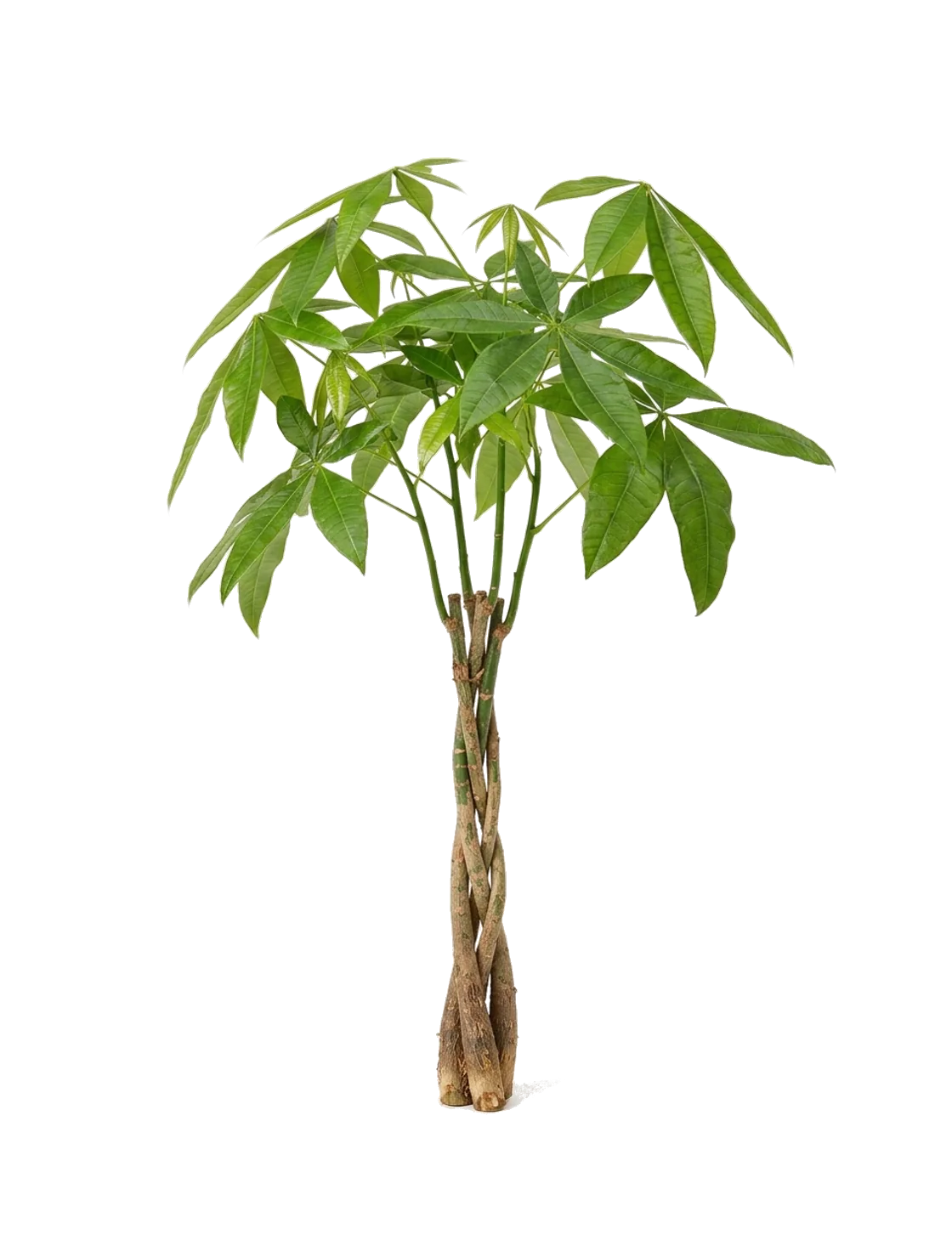
Money tree (Pachira aquatica) is a tropical tree with an often braided trunk and glossy, palmate leaves. It belongs to the Malvaceae family and comes from the swamps of Mexico, Central America and South America, where it grows along rivers and estuaries. Indoors it lives as an elegant small tree that takes well to pot life. Young nursery plants are often sold with several stems braided together.
It asks for bright, indirect light and moderate watering, letting the top centimetres dry between waterings. Soak thoroughly once the surface feels dry and empty the saucer so no water stands. It grows well between 18 and 28 °C and cannot stand cold below 12 °C.
Overwatering is its main enemy: it softens the trunk and yellows the leaves within days. It tolerates formative pruning and resprouts readily from old wood. With enough light and repotting every two or three years, it becomes a long-lived plant with great presence. Wipe the leaves now and then to keep them glossy.
Did you know?In the wild it bears large night-blooming flowers pollinated by bats, and can reach 20 metres tall.
Care. What it needs, point by point.
- Watering
- Water thoroughly when the top two or three centimetres of soil feel dry. Always empty the saucer so the roots never stand in water. In winter, space waterings out, as the plant grows more slowly.
- Light
- IndirectIt needs bright, indirect light and tolerates some gentle morning sun. In dim light it sheds leaves and grows lanky.
- Temperature
- 18–28 °C ideal temperatureIt grows well between 18 and 28 °C and suffers in the cold. Shield it from cold drafts and never expose it to less than 12 °C.
- Soil
- Use a loose mix with good drainage, such as universal soil with perlite. Water should run quickly out of the drainage holes.
- Fertilizer
- Feed once a month in spring and summer with a balanced liquid fertilizer. Do not feed in autumn and winter.
- Pruning
- It tolerates formative pruning and pinching to keep its size and shape. Cut just above a node to stimulate regrowth.
- Propagation
- Propagate from stem cuttings in spring, with gentle warmth and steady moisture. It is a slow method, with uneven rooting.
Where it grows. In the wild and in homes.
In the wild it grows in South and Central America and the Caribbean and North America, in a wet tropical climate.
People have also taken it to 13 more regions where it now grows on its own: South and Central America and the Caribbean, Africa, and the Pacific.
Range: Plants of the World Online, Royal Botanic Gardens, Kew
Is Money tree toxic to cats and dogs?
Non-toxic to cats and dogs.

Cats
Non-toxic

Dogs
Non-toxic
Source · ASPCA Animal Poison Control
Common problems What tends to go wrong.
- Overwatering
- Root rot
- Too little light
- Mealybugs and scale




Frequently asked questions What people ask most.
Why are the leaves yellowing and falling?
It is almost always overwatering or a pot without drainage. Let the soil dry and check that water flows from the holes. If the trunk feels soft, cut water at once and improve drainage.
How often should I water it?
Water thoroughly when the top two or three centimetres feel dry, normally every seven to ten days indoors. Adjust the rhythm to the light and warmth of your home. In winter, water less, as the plant uses less water.
Does it need a lot of light?
It grows best in bright, indirect light and tolerates some gentle sun. In dim light it sheds leaves and the shoots emerge weak. Turn the pot now and then so it grows evenly.
Does the braided trunk need any special care?
It needs nothing special, but check that the ties never tighten as it thickens. The braid is decorative and only calls for trimming shoots that sprout below. If a stem dries out, cut it away without fear.
When should I repot it?
Repot in spring every two or three years, into a slightly larger pot with good drainage. Use the moment to check the roots and cut away any soft or damaged ones. Afterwards, water moderately for a few weeks.