Living stones
Lithops lesliei
Living stones (Lithops lesliei) care: when to water around the yearly splitting, maximum light and mineral soil for autumn flowers on the sill.
- Light
- 4–5 hof direct sun
- Temperature
- 20–30 °Cideal temperature
- Toxicity
- Non-toxic
- Difficulty
- Hard
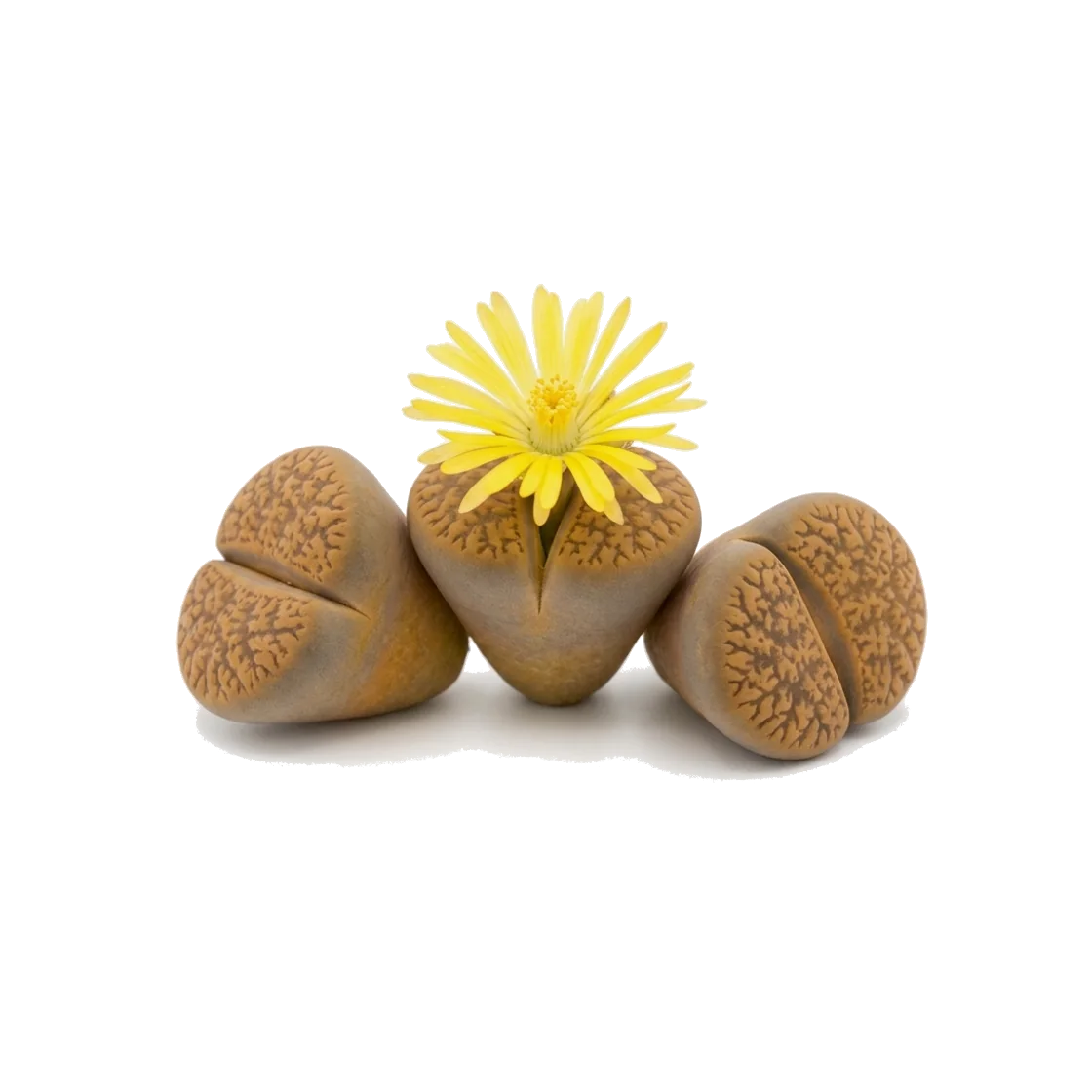
Living stones (Lithops lesliei) are miniature succulents from the rocky plains of South Africa, famous for mimicking the pebbles around them. Each plant is no more than a pair of thick, fused leaves in grey, brown or greenish tones, patterned with windows and speckles on the flat top. This camouflage protected them from grazing animals, and it still delights collectors who grow trays of different colours and patterns side by side.
Their yearly cycle is unlike that of ordinary houseplants and must be respected for them to survive. In autumn yellow or white flowers open from the central slit, then in winter the plant must stay dry while a new leaf pair quietly absorbs the old one. New growers often kill them with kindness: one untimely watering during the leaf change can rot the whole plant within days.
Grown correctly, they are long-lived and flower reliably each autumn in a sunny spot. They need a tiny clay pot, a nearly pure mineral substrate and a firm hand with the watering can. Lithops lesliei is one of the easier species in the genus, which makes it a good first living stone for a patient beginner.
Did you know?Each plant is a single pair of fused leaves with a slit on top, and the flowers that emerge from that slit can be wider than the plant itself.
Care. What it needs, point by point.
- Watering
- Water only from late summer into autumn, when the old leaves dry and flowers appear. Keep it completely dry in winter and during the spring leaf change.
- Light
- 4–5 h of direct sunGive it as much direct sun as possible, at least four to five hours a day. Weak light makes the bodies stretch tall and lose their markings.
- Temperature
- 20–30 °C ideal temperatureIt thrives between 20 °C and 30 °C in the growing season and rests cool and dry in winter. Keep it above 5 °C and never water it in the cold.
- Soil
- Use an extremely mineral mix, at least eighty percent pumice, grit or coarse sand. Organic soil holds too much water and rots the plants.
- Fertilizer
- It hardly needs feeding; a very light dose of cactus fertiliser once a year in autumn is plenty. Too much feed causes soft, oversized growth.
- Pruning
- No pruning is ever needed. Just lift away the dry skins of old leaves when the new pair has fully absorbed them.
- Propagation
- Sow seeds in autumn on pure mineral grit and keep them lightly moist until germination. Seedlings grow slowly and need their first year of careful watching.
Where it grows. In the wild and in homes.
In the wild it grows in southern Africa, in a desert or dry shrubland climate.
Range: Plants of the World Online, Royal Botanic Gardens, Kew
Is Living stones toxic to cats and dogs?
The ASPCA doesn't list this species. If your pet has chewed it and seems unwell, call your vet.
Common problems What tends to go wrong.
- Overwatering
- Root rot
- Too little light
- Transplant shock



Frequently asked questions What people ask most.
When should I water living stones?
Water sparingly from late summer to mid-autumn, only when the soil is dry and the plant is not splitting. Stop completely in winter and throughout the spring leaf change. When in doubt, skip the watering: drought rarely kills them, water does.
Why is my lithops stretching tall and pale?
Stretching means it needs far more light than it gets, a classic sign of windowsill life without direct sun. Move it gradually to full sun of four to five hours a day. The stretched leaves will not shrink, but the next pair will grow low and compact.
Should I remove the old dry leaves?
Leave them alone until they are papery husks that come away with a gentle tug. The new leaves feed on the old pair for months, and pulling early weakens the plant. Never water just to soften the old skins.
Do living stones flower indoors?
Yes, mature plants flower in autumn when they get strong sun and a correct dry rest. Buds appear in the central slit and open into silky yellow blooms. A cool, dry winter rest helps set the buds for the following year.